The Meaning That Crosses the Border
507 words
When Mara agreed to translate her grandmother’s letters, she expected the work to be difficult in the familiar way: old handwriting, references to people no longer alive, sentences whose beginnings had wandered far from their endings. What she did not expect was that the letters would seem to change as she read them. In their original language, her grandmother’s voice was brisk and teasing. In English, the same remarks sounded almost severe. A phrase that literally meant “to keep a little sun in your pocket” described someone who could remain cheerful in bad weather; rendered word for word, it suggested an eccentric habit rather than a temperament.
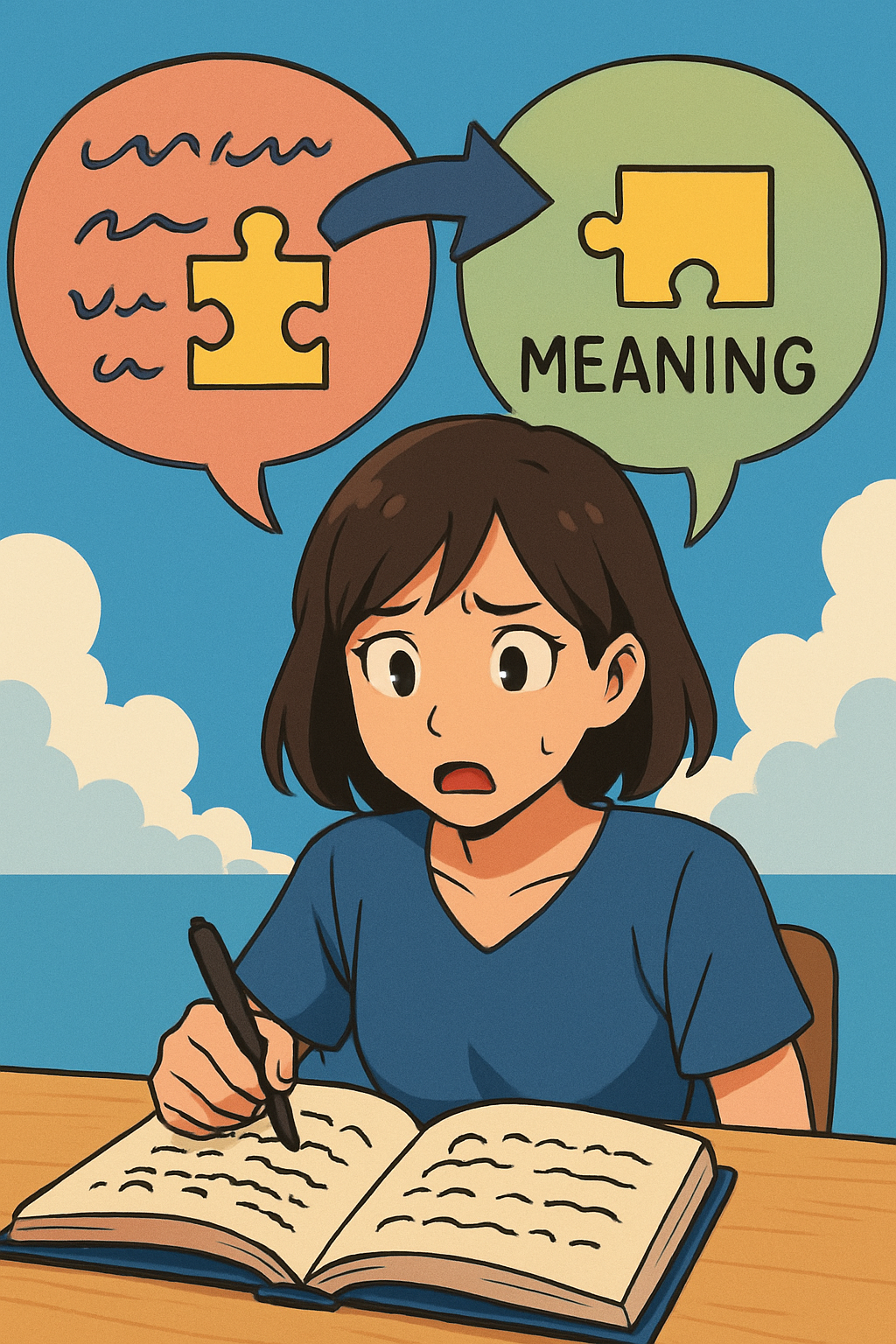
Mara began to see that translation was less like carrying a sealed package across a border than rebuilding a house with materials found nearby. Some features travelled easily: dates, names, the sequence of events. Others depended on the grain of a particular language—the rhythm of a proverb, the double meaning of a verb, the social distance implied by a choice of pronoun. Even silence could be grammatical. Her grandmother sometimes omitted a subject because the listener would understand who was acting. English demanded a name or pronoun, and each addition made the sentence more explicit, but also more definite than the original had been.
The problem was not simply that one language possessed words another lacked. Languages also trained their speakers to notice different relations. In one letter, her grandmother used a word that could mean both “remember” and “bring back to the heart.” The narrower English verb preserved the practical sense but left the emotional movement behind. Mara tried “recall,” then “cherish,” then a phrase that seemed accurate but heavy. Each choice illuminated one side of the word while casting another into shadow. She understood why translators sometimes kept a foreign term, not to display their cleverness, but because explanation could flatten what a compact expression held together.
Yet translation gave the letters something they could not have in their first language alone. Mara’s English version made her grandmother’s experience available to cousins who had never learned to read the original. It also forced Mara to examine what she had previously taken for granted. She noticed the humour hidden inside a complaint, the tenderness concealed by an abrupt instruction. Translation did not merely transfer understanding; it created a new occasion for it. A sentence might lose its familiar cadence and gain a different kind of intimacy, one built from the translator’s careful attention.
When the final letter was finished, Mara placed the two versions side by side. Neither seemed complete, and neither seemed false. The English text could not reproduce every echo, but it carried the shape of a life across a distance that would otherwise have remained closed. Mara added a brief note where no single phrase could do the work, then left other ambiguities intact. She had learned that fidelity was not always a matter of matching words. Sometimes it meant preserving uncertainty, or allowing a reader to feel the outline of something that had not crossed.