When Knowledge Changes Shape
553 words
In the winter of 1919, astronomers gathered to hear whether a distant eclipse had confirmed Albert Einstein’s prediction that gravity bends light. Newspapers soon announced that Newton had been overthrown. The phrase was dramatic, but misleading: Newton’s equations still guided bridges, satellites, and falling apples. What changed was not the usefulness of an old theory in every circumstance, but the reach of its authority. Einstein’s account explained phenomena Newton’s could not, and it recast gravity itself—not as a force acting across empty space, but as a consequence of curved spacetime.
Such episodes are often called scientific revolutions. The philosopher Thomas Kuhn gave the term much of its modern force, arguing that scientists usually work within a shared framework, or paradigm. A paradigm supplies more than a set of theories: it shapes which questions seem important, what instruments are trusted, and what counts as a satisfactory answer. During ordinary research, scientists refine this framework, solving puzzles that it has made visible. Yet anomalies accumulate. Most are initially treated as errors, technical difficulties, or problems awaiting a clever solution. Only when some anomalies become consequential, and an alternative framework gains credibility, does a crisis become possible.
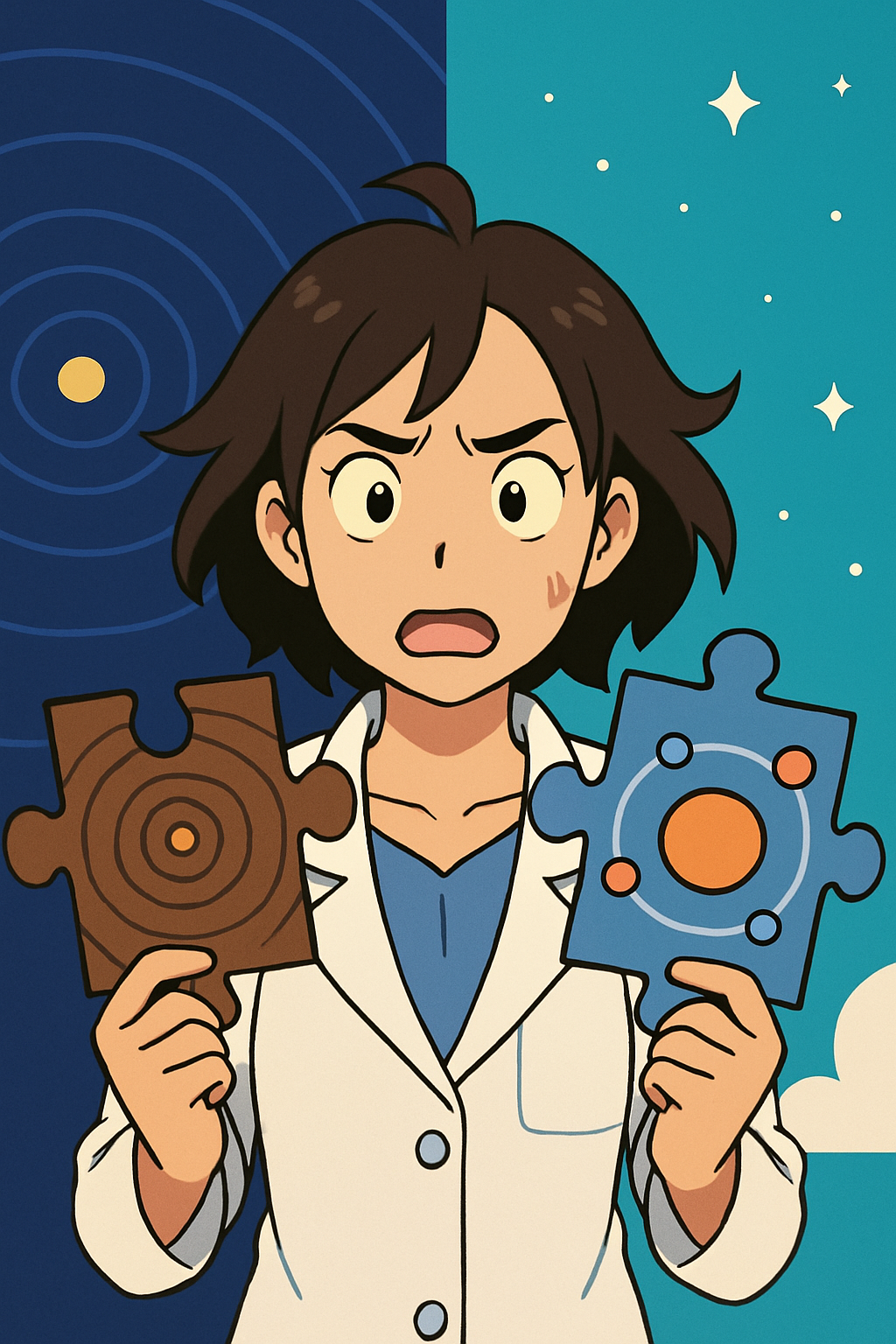
A revolution, then, is not simply the discovery of a surprising fact. Evidence does not arrive with its interpretation attached. Consider the shift from the idea that diseases arose from imbalances within the body to the recognition that particular microorganisms could cause particular infections. The new account gained strength through instruments, experiments, and practical success: researchers could identify pathogens, test causal claims, and prevent or treat some diseases. But the transformation also altered the questions physicians asked and the kinds of evidence they sought. What had counted as a compelling explanation in one framework could appear incomplete in another.
This does not mean that scientific knowledge is arbitrary, or that every theory is merely a fashion. The natural world resists explanations that fail to predict, organize, or withstand scrutiny. Nor does a new paradigm erase everything that came before. Older models may remain reliable within a limited domain, even after their deepest assumptions have been revised. Scientific change is therefore both discontinuous and cumulative: concepts may be reorganized, while observations, techniques, and useful approximations survive. The boundary between the two is often contested, and historians may describe the same transition as either rupture or development.
What counts as knowledge depends partly on methods and standards, but those standards are themselves tested against experience. A measurement becomes persuasive when instruments are calibrated, results can be reproduced, and independent lines of evidence converge. Even then, certainty is rarely absolute. Scientists make judgments about which anomalies matter, which risks a theory can tolerate, and what evidence would change their minds. These judgments are not defects to be eliminated; they are part of how inquiry works, provided they remain open to challenge.
Scientific revolutions reveal, above all, that knowledge is not a finished storehouse but a disciplined practice of correction. Paradigms make investigation possible by directing attention, yet they can also make some possibilities difficult to see. The history of science is not a steady march from error to final truth, nor a sequence of unrelated opinions. It is a record of communities learning to notice what their assumptions obscure—and devising better ways to ask what the world will allow them to claim.