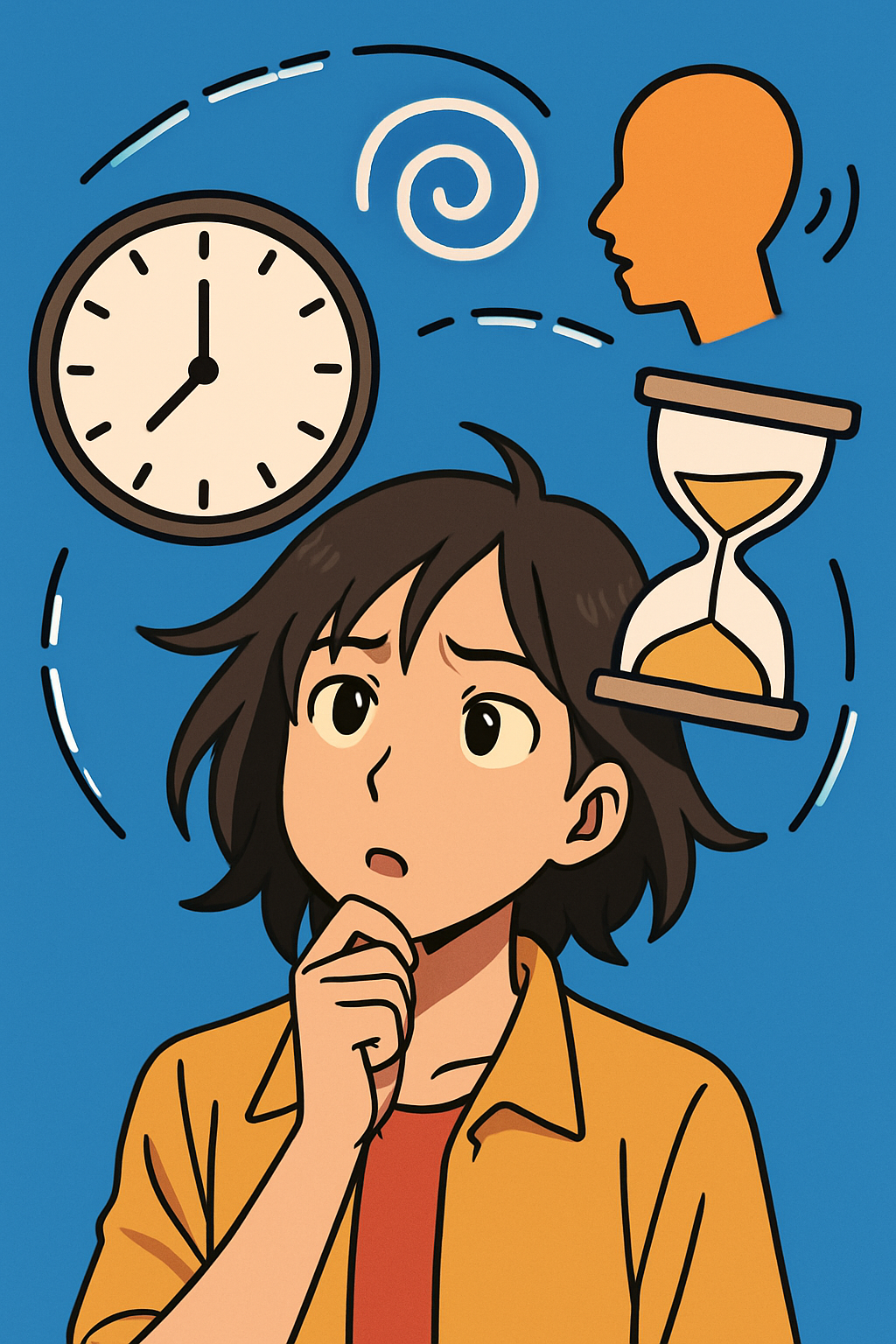
The Many Clocks We Carry
510 words
At 8:17 on a winter evening, Mara waited for a train that was twelve minutes late. The station clock advanced with indifferent precision, yet the delay seemed to stretch as she watched the empty track. Across the platform, a child swung a paper ticket and declared that the wait was “about a hundred years.” His father laughed. Mara did not. She had spent the day in a laboratory studying clocks, and she knew that the child’s exaggeration contained a small truth: time can be measured uniformly while being experienced unevenly.
Physics offers a strikingly impersonal account. In classical mechanics, time was treated as a universal background against which events unfolded, much like a vast, invisible ruler. Einstein’s theories altered that picture. A clock in motion, or situated in a different gravitational field, can record a different amount of elapsed time from another clock. The discrepancy is not a flaw in either instrument; it reflects the structure of the universe. At everyday speeds and distances, these effects are too slight to notice, but satellite navigation systems must account for them. Without such adjustments, their calculations would gradually drift. The clock, it turns out, is not merely measuring time: its circumstances help determine what it measures.
The mind, meanwhile, keeps a less dependable ledger. An absorbing conversation may vanish into what feels like a few minutes, whereas an anxious wait can acquire the weight of an hour. Attention and memory both contribute to this elasticity. When we monitor every passing moment, we register many small changes, which can make an interval feel prolonged. In retrospect, however, a day rich in unfamiliar experiences may seem expansive, because it leaves a dense store of distinct memories. A routine week, sparsely marked by new impressions, may appear to have disappeared. Thus the length of time as lived and the length of time as remembered need not agree.
Cultures also teach people how to notice, divide and value time. Some social settings prize punctuality and treat schedules as promises; others give greater weight to relationships and circumstances unfolding in the present. Neither orientation is simply a matter of discipline or carelessness. Each carries assumptions about what deserves priority and how coordination should work. Even calendars, though useful, embody choices: they organise cycles, commemorate events and make certain rhythms socially visible while leaving others in the background. A society’s time is therefore not only counted but interpreted.
When Mara’s train finally arrived, she found the child still studying his ticket. She asked whether the wait had really lasted a hundred years. “No,” he said, “but it was longer before the train came.” Mara smiled at the precision of his answer. The station clock had recorded the interval; relativity explained why clocks can disagree; psychology clarified why the wait had seemed to swell; and culture had supplied the expectation that the train should arrive on schedule. None of these accounts cancelled the others. Together, they suggested that time is at once a physical dimension, a mental experience and a shared human arrangement—one reality approached through several different clocks.